Sunday, 22 May 2011

Cape winelands: Europe meets Africa

Stellenbosch, just under an hour's drive from Cape Town, is a pretty, oak-tree lined university town surrounded by wine farms. Whenever work used to take me there, I'd leave early in the morning to avoid traffic on the national road, and I'd be driving through vineyards at sunrise, to have early coffee in Dorp Street (below), where the houses and shops go back to the 1700s. 


The legacy of the Europeans in Africa is here - the Dutch, whose governor founded this town in 1679 ... 


and the French, who settled in nearby Franschhoek below...


The French Huguenots, hot-footing it to Africa away from persecution in 1600s France, found compensation here after they crossed the mountains, above, into this lush valley that was perfect for planting vines and practising the art of wine-making - something they knew plenty about. 
They named their new farms after the areas in France they came from and the vineyards they'd left behind ... La Motte, Cabriere, Provence, Chamonix, Dieu Donné, La Dauphine and many more still exist today in this part of the Cape winelands.


They called the area Le Coin Francais, their little French corner of Southern Africa (later translated by the Dutch to Franschhoek).


The 'Cape Dutch' style of their gabled houses (shades of old Amsterdam) is actually a mix of Dutch, French, German and Indonesian styles unique to this part of the world. They were built by slaves imported from the east who were skilled craftsmen, from local materials - clay, sea-shells, wild reed, slate from Robben Island ...


Some had the vision to plant vines high up on the mountain slopes. Delaire is the 'vineyard in the sky' at the top of Helshoogte mountain pass (meaning hell's height, or a hell of a height) with these spectacular views of the Banhoek valley, framed by mountain ranges ...


You used to be able to have a relaxed picnic under the trees here while enjoying the views, but no more. In a contemporary version of European colonisation, Delaire has been bought by self-made (Stepney to Bond Street) billionaire jeweller, Laurence Graff and had a multi-million make-over. Rustic Cape Dutch has disappeared and in its place is a contemporary fusion of African and ... I'm not sure, really, but it makes a statement of its own even if accessible mainly to the very rich ...


Graff has gathered works of art by contemporary South African artists, including sculptor Dylan Lewis (his fabulous big cats are against the mountain backdrop in a photo above).


What would the Huguenots make of all this?

Tuesday, 17 May 2011

Montebello: forest phantasms

Where do you go for a lazy, lingering breakfast on a sunny weekend morning in Cape Town, maybe as a prelude to a walk on the  mountain or a day on the beach?


A favourite place of ours is the Gardener's Cottage, above and below, in the old farm buildings and forested land of Montebello, in Newlands. Sitting under the trees in the shade of the mountain, it feels like being deep in countryside rather than in the middle of a city suburb. 


The food is simple, unpretentious and best quality, and after you've indulged, there's a whole range of interesting distractions to explore, because in and around the old farm buildings are small workshops and cottage industries promoting local art and design, a working iron forge and a plant nursery ...


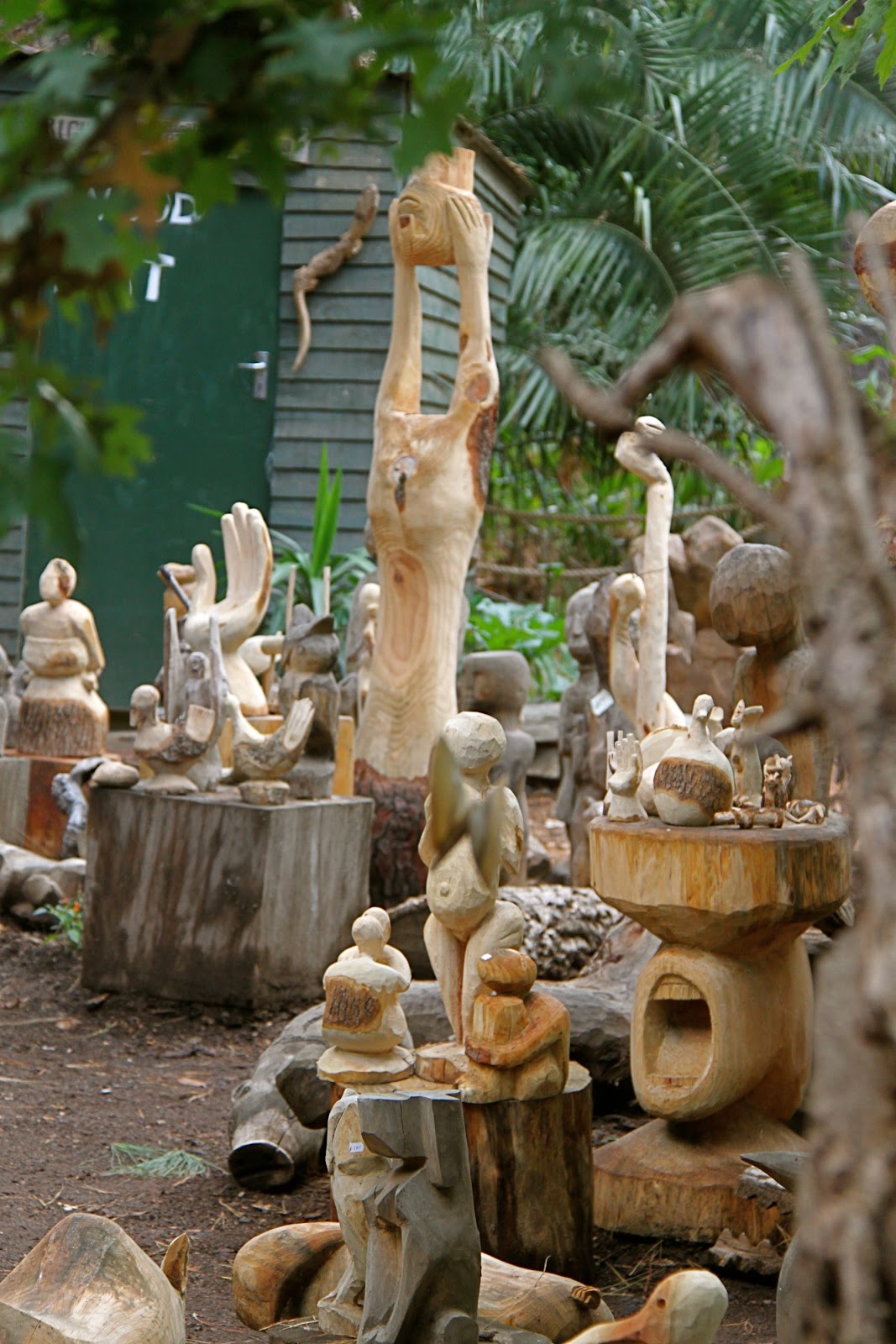
And seemingly growing out of the forest behind the forge, 


you walk into an extraordinary world of a woodcarver's imagination ...


His creations seem to grow organically out of the tree stumps he carves from ...


A tree becomes a hand becomes a plant holder ...


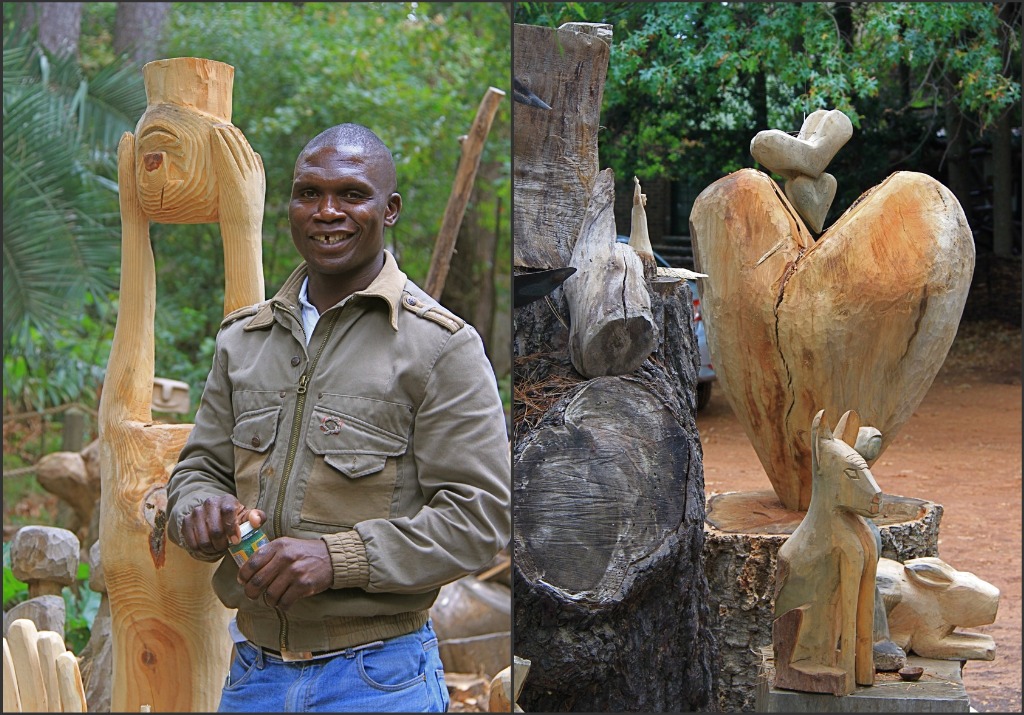
And here is the man with the vision behind all these creations - wood carver Right Mukare from Zimbabwe ...

Saturday, 14 May 2011

Made from the heart, feeding the belly

Something I love to do in Cape Town is check out the latest in locally-created arts and crafts. What's being sold on pavements, at traffic lights, in market stalls, and what's made it into the shops? When resources are few and making ends meet is a daily struggle, inventiveness and creativity become a life support for many. Scrap metal, telephone wire, plastic bags, paper clips and fabric scraps are transformed into as many different functional and decorative objects as the imagination can dream of.

Can you guess what this dress is made from?


No? Sorry, you'll have to wait until later in this post to find out! ...


People with the means to do so have been quick to spot the commercial value of supporting struggling craftspeople with talent. But how much of the profits return directly to the artists and their communities?


Heartworks (above and below) has been a favourite place for me and my daughters for ages. Started by Margaret Woermann, with the intention of promoting "artworks made by the heart, but with the ultimate objective of feeding the belly", giving talented but marginalised people the opportunity to earn a living,  she travels all over the country looking for talent. As well as finding stock for her shops she develops relationships with many crafters that help them grow their businesses.


A new discovery for us on this trip was T Bag Designs, right next door to the township of Imizamo Yethu, in a corner of this historic building in Hout Bay ...


... where a group of 20 previously unemployed township residents work on a collective creative project making artefacts exclusively from used tea-bags.


Friendly and welcoming Russell Chitanda, above left, showed us around their workshops. As this group has become better known, local residents of Hout Bay and even people from far-off countries (Hillary Clinton was one well-known visitor) send or bring in stashes of used tea-bags. The dried tea-bags are  (clockwise from left below) emptied out, ironed flat, painted and/or cut out in shapes ...


They're then decorated, glued, embossed, embellished in a hundred different ways to make cards, notebooks, découpage boxes, coasters, tea-light holders, placemats, wrapping paper ... even the dress in the first pic above!


(Did Hillary buy the card at bottom right, above?)


Finished products are sold in the factory shop, above, as well as at the craft emporium at Cape Town's Waterfront. I think my favourite of all are these delicate, hanging tea-bag angels ...


You can find out more about the people who make TBag Designs work over here. And just a few more organisations that promote South African craft fairly and responsibly (as far as I know) and have beautiful products include Monkeybiz, Montebello (will be a later post), and Streetwires. To read and for photos that inspire, look at Shack Chic (and here), or Craft South Africa. Go take a look - you might get as hooked as I am ...

Tuesday, 10 May 2011

Township Life: Imizamo Yethu

From the vineyards to the townships ... this is a land of contrasts.
Hout Bay, in a valley on the Atlantic side of the Cape peninsula, is home to a mix of people from the very rich to the very poor. You reach it either via a road that winds down the mountainside from Constantia's highest vineyards, or via an equally winding but vertiginous coastal road with spectacular ocean views (Chapman's Peak Drive) ...


Down in the valley, extending from the town's pretty main road up the mountainside, is the sprawling settlement called Imizamo Yethu (in Xhosa 'our collective struggle/efforts'), also known as Mandela Park.


Somewhere between informal settlement and fully-fledged suburb, it has shacks made of corrugated iron sheets and random found-and-resurrected house parts, alongside more solid brick houses built mainly through funding from a charitable housing foundation.


Some look so precarious that you wonder how they can possibly survive the Cape winter rains and storms ...


This is home to 20 - 30 thousand families. Most have come to Cape Town in search of work - either from the Eastern Cape (many are from rural Transkei, birthplace of Nelson Mandela) or as refugees from other African countries - Zimbabwe, Congo, Zaire...


Over the last two decades that have seen this settlement grow exponentially, local government has provided roads, some (extremely) basic water and sewerage facilities, schools and a health clinic.


There is pay-as-you-go electricity (monitored via the numbers you see painted on shacks). In the photo below right you can see a satellite TV dish! Below left, a makeshift open drain pipe carries water from an inside sink to the ground outside.


What strikes you overwhelmingly about this place is its life. It practically heaves with activity. There's music everywhere, coming out of bars, shops and homes. Cars (literally the only thing that made me afraid here) roar up and down the steep roads, windows open and music blaring, causing people and dogs to scatter. Conversations were happening everywhere in the streets ...


This grandpa was supervising the kids' play in a fenced-in yard ...


while others played on the sidewalks ...


Best friends? ...


Small businesses thrive here. Spazas (convenience shops) like the one below mean that many essential items can be bought close to home ...


Small-time entrepreneurs abound, as people are willing to offer just about any service if it can make a small profit ...


Hair salons do brisk trade. Here is a glimpse inside one of these, in a converted container ... 


Barbed wire doing double duty as a clothes line, below, and around a pre-school is a reminder that crime is also rife ...


Iziko Lobomi (centre of life, though iziko means 'hearth') community centre, run by a local Christian group, provides skills training, a soup kitchen, social services, and a venue for people to make and sell arts and crafts.


The dogs caught my heart too, especially as one of my own started life in this township 


My favourite pic of all? This little girl who waved at us from the window of the bus taking her home from day-care (her friend's hand waving like a starfish above her head)...


Related Posts with Thumbnails